Hello.
I want to come back. I want to read more. Don't get me wrong, Pokemon is still high on my list of media consumption. I'm getting more records in the mail as we speak. And I still have my Netflix subscription and a big TV. And the Wii, of course. My point is that I have a lot on my plate to watch, listen to, and read.
But I need to re-balance my diet, and it needs to happen now. Books are going to move up that list, and magazines of high quality will tag along for the ride. Part of my inspiration is that a very literary friend of mine is now encouraging me to read a particular book, and I am obliging. This work is a sequel of sorts to one of the best things I've ever read, The Power of One, by Bryce Courtenay. Tandia is apparently his thick follow-up to that wonderful novel, and I can't wait to dig in. And this time I will share.
I am on a bit of a spending spree, and I am wrapping it up with a splurge on Believer and McSweeney's subscriptions. Huzzah! So I look forward to those in the mailbox.
I'm curious about something. Well, first let me thank Ben, one of my dearest friends for soldiering on in my absence. Can we get a roll call of Book-Loop readers? Bryan, you're still here, right? Ben, how do you feel about a renewed effort to recruit?
Crazily, we are approaching the one year anniversary of Book-Loop. How shall we celebrate, friends?
Tuesday, June 5


Friday, June 1
You Can't Go Home Again
In my mind Thomas Wolfe is running laps around every author I have read in, oh, say, the last year. Hemingway has passed out on his belly, Philip Roth has slowed to a walk and seems to be fighting a stomach cramp, why, even Camus has taken a knee and requested a glass of water. Meanwhile, Wolfe appears unwinded and dashes forth with an easy gate. Unfortunately he is also quite dead. I should note that I do not view the art of writing in these terms, a foot race. It is, however, the apparent effortlessness of Wolfe's writing that I admire in these early pages of his final novel. Of course, to call it effortless is in itself problematic, but you get the point.
Sunday, May 13
Dusty Twain, Dusty Durrell
The Adventures of Huckleberry Finn! Bought a 1964 pocket paperback complete with illustrations and some really swell marginalia, including, “Huck thinks Tom’s great” and “Huck shows diplomacy” and “Huck rationalizes his mental conflict” and “Huck apologizes, very out of order because a white person never lowers himself to a negroe [sic]” and on.
Also procured a 1969 paperback edition of Lawrence Durrell’s Justine, the first book in The Alexandria Quartet. I’ve been meaning to pick this up for some time. Of the books I have read that are near and dear to my father’s heart (The Magic Mountain, The Magus, The Deptford Trilogy, Le Grand Meaulnes, among others) I have nothing but love. He highly recommended the Alexandria Quartet about 18 months ago and I have been slow to comply. The first page, woo-ha:
Also procured a 1969 paperback edition of Lawrence Durrell’s Justine, the first book in The Alexandria Quartet. I’ve been meaning to pick this up for some time. Of the books I have read that are near and dear to my father’s heart (The Magic Mountain, The Magus, The Deptford Trilogy, Le Grand Meaulnes, among others) I have nothing but love. He highly recommended the Alexandria Quartet about 18 months ago and I have been slow to comply. The first page, woo-ha:
The sea is high again today, with a thrilling flush of the wind. In the midst of winter you can feel the inventions of Spring. A sky of hot nude pearl until midday, crickets in sheltered places, and now the wind unpacking the great planes, ransacking the greats planes. . . .
I have escaped to this island with a few books and the child—Melissa’s child. I do not know why I used the word “escape." The villagers say jokingly that only a sick man would choose such a remote place to rebuild. Well, then, I have come here to heal myself, if you like to put it that way. . . .
At night when the wind roars and the child sleeps quietly in its wooden cot by the echoing chimney-piece I light a lamp and walk about, thinking of my friend—of Justine and Nessim, of Melissa and Balthazar. I return link by link along the iron chains of memory to the city which we inhabitated so briefly together: the city which used us as its flora—precipitated in us conflicts which were hers and which we mistook for our own: beloved Alexandria!
I have had to come so far away from it in order to understand it all! Living on this bare promontory, snatched every night from darkness by Arcturus, far from the lime-laden dust of those summer afternoons, I see at last that none of us is properly to be judged for what happened in the past. It is the city which should be judged though we, its children, must pay the price.
Saturday, May 12
Some Links
- Goethe's Bright Circle
- Tintin's new adventures
- Curling up with a good ebook
- Book Reviewers — Who Needs ’Em?
- Karl Marx library fights Communist 'take-over' bid
- Philip K. Dick: A pulp sci-fi writer finally wins respect
- Cops and Rabbis: A review of Michael Chabon's latest novel
- Wretched of the Earth: A look at two new books on poverty
- Makers of Dylan Thomas biopic focus on poet's tangled love life
- The readiness to deconstruct is all: A look at two new books on Shakespeare
- A Man, a Woman and a Day of Terror: A review of Don DeLillo's latest novel
- The ultimate literary pilgrimage – to walk from Oscar Wilde's London home to James Joyce's Zurich retreat.
Finn
Tom Ashbrook recently sat down with Jon Clinch, author of the new novel Finn. The novel covers in great detail an aspect of The Adventures of Huckleberry Finn that Mark Twain focused on only glancingly, the story of Pap, Huck's father. In Clinch's telling Pap comes from fairly noble beginnings and though he is a virulent racist he has a child with (and perhaps even loves) a stolen slave. As you might have guessed this slave, Mary, is Huck Finn's mother, which adds an interesting dynamic to his relationship with Jim. Now, regardless of Twain's own designs of Pap's backstory, what we have in the original text is a fairly broad outline of a drunk, racist, evil father and so Clinch had quite a bit of room to work with. I applaud him for attempting to flesh out one of the great villains of American literature, and for doing it in the form of a dark, by some accounts disturbed, novel. I am fascinated by this book. I want to read this book. But first, I must re-vist the original text. Should be fun.
Los Angeles Times Finn review
Washington Post Finn review
Also stopping by On Point with Tom Ashbrook this week, Clive James.
Los Angeles Times Finn review
Washington Post Finn review
Also stopping by On Point with Tom Ashbrook this week, Clive James.
Sunday, April 22
Flotsam and Jetsam
- The Art of Vengeance: Roald Dahl's Collected Stories
- The Unclosed Circle: Joan Didion's Collcted Nonfiction
- Why so many novels never make it to the big screen
- Kurt Vonnegut: Me myself and I
- Vonnegut's rules for short stories
- Jonathan Bate on Shakespeare's popularity
- Where Raymond Carver Is Now Calling From
- The Death of the Book, Again
- Great forebodings about Dickens World
- Lost: Catch-22
- Flaubert & Writing Oneself
- The Curtain by Milan Kundera
- The mystery of The Da Vinci Code's success
- The Holocaust's indelible witness
- Dissecting the Body: Colm Tóibín on Ian McEwan
- Storms Over the Novel
Thursday, April 12
Tuesday, March 20
Lazy
One of these days I might get back to blogging semi-regularly about what I am reading. But as I am squeamish about turning this into my personal reading journal, rather short on time and not entirely sure a soul on earth even visits this blog, I don't believe it's in the cards. I am now reading Nick Hornby's Housekeeping vs. The Dirt, a fine example of the type of casual, personal accounts of a reader's life that might just thrive on this page. I recently discovered Salon's Literary Guide to the World. I am fairly certain this is not a new creation but it's new to me, and it's quite exciting. But that's about all I got right now. Here are some interesting articles:
- Jane Addiction
- The Last Antiwar Poem
- The Worst Pulp Novelist Ever: Remembering Leo Guild
- Words and music: The literary afterlife of the Fall
- Susan Sontag: Pay attention to the world
- Joyceans bent on resolving playful 'Wake'
- Is Joan of Arc the prototype for modern celebrity?
- In pursuit of Anthony Burgess: Bell bottoms in the rainforest
- Mishima's Sword: Travels in Search of a Samurai Legend
- Souls of the new machine: How our reliance on the online universe can endanger the vital tool of narrative
Friday, March 16
A baker's dozen to chew on
- Come for the Xbox, stay for the books
- Kundera's musings on the novel
- You’ve Read the Novels (Now Read the Footnotes)
- Roots of the modern novel: 18th century London streets
- Rare finds make stacks of cash for book scouts
- Best of enemies: The truth behind a 30-year literary fued
- Interview with Richard Powers
- If you're cleaning up kids' books, look to fairytales first
- Márquez avoids 80th birthday celebration to walk with Castro
- Think you know how to read, do you?
- The long way round: VS Naipaul
- Review: Through the Children's Gate: A Home in New York
- TS Eliot's greatness as a poet is established beyond all doubt. So why do critics feel the need to defend him against all charges of misogyny and antisemitism?
Sunday, March 11
The Portrait Game
 On a recent Saturday afternoon at the Seattle Public Library I discovered an exceptionally swell book by the name of The Portrait Game. In autumn of 1856 Ivan Turgenev was visiting Château de Courtavenel, the French country home of singer-actress Madame Pauline Viardot--the very same location where Turgenev spent a lonesome winter working on A Sportsman's Sketches. One evening, while he and the other guests were socializing in the drawing room, Turgenev invented a simple game in which he sketched a profile at the top of a long sheet of paper. Turgenev then wrote a brief description of the freshly invented character, folded the paper over to conceal his writing and passed the paper around the room, with each participant writing their own description (some as short as one sentence, others much longer). The sheet of paper would eventually find its way back to Turgenev and he would read aloud each of the descriptions.
Remarkably Turgenev saved these pages with his drafts and they were published in a slight, and apparently long out-of-print collection titledThe Portrait Game. The book was a fun and unexpected diverengence from my somewhat scholarly pursuits in the Russian literary criticism section. Turgenev’s drawings are greatly detailed and varied given the apparent brisk pace of the game. It was interesting to read how each player responded to Turgenev's drawings (often quite similarly) and even though, as the writer of the bunch, Turgenev's descriptions are generally the more artistic, I found just about all of the responses to be worthwhile. Here are a few of my favorites from Tugenev’s pen:
Wanton, under a cool chaste look; good-natured but insignificant, without a truly interesting quality; she will only be liked by insignificant people.
By nature a horse-traded; repulsive creature. He's an American or Englishman —— very raw. An ignoble buck —— I spit on his goatee, soaked with vile swindler's sweat.
Big English farmer——a brute bull, and nearly wild——eats eight pounds of bloody meat per day and drinks eight bottles of porter——imperious, despotic, and violent——not without a kind of wiliness. A voice hoarsened by fat——has a lot of money——if he hadn’t, he would be capable of killing for it.
Just as an aside, it was interesting to learn that Turgenev was hopelessly in love with the married Viardot, and indeed it seems he rather sadly followed the couple around Europe—the group played portrait game eight years later in Bade-Baden. Also, it was inspiring to discover that the drawing room at Château de Courtavenel was, in fact, actually used for drawing!
Ahem...
From the pages of Playboy:
Peerflix (peerflix.com) is a smart new alternative to DVD rent-by-mail services. You list the DVDs you want, along with ones you own but don't want anymore. When someone requests one of yours, print a postage-paid mailer on regular paper, tape it and send it. That earns you credits you can use to order DVDs on your want list. Discs you get are yours to keep, and you can cash out at any time. Very clever.
Hmmmm, there may yet be hope...
Saturday, February 3
Letters Lost
I read a review of the recently released Letters of E. B. White, Revised Edition in The Times a fortnight ago and it got me thinking.....
Gmail Chats of Prometheus Diaphanous
Prometheus: Clancy!
Tom Clancy: hey
Prometheus: You read the The Bourne Trajectory yet?
Tom Clancy: nope
Prometheus: That Ludlum, he keeps spittin em out from the grave!
Tom Clancy: ghostwriter
Prometheus: Good one, Clancy!
Tom Clancy: no I'm serious, Ludlum and I share ghostwriters, been doing it for years
Prometheus: When was the last time you wrote a book, Clancy?
Tom Clancy: early 90s
Prometheus: wow
Tom Clancy: yup
Prometheus: I mean, damn!
Tom Clancy: yeah
Prometheus: so it's all about the video games these days, eh, Clancy?
Tom Clancy: gotta go, Splinter Cell beckons
Voice Messages of Prometheus Diaphanous
Hello, Ovid, it's Prometheus. Sorry it's been so long. I was walking by that donut shop on Wilshire and I thought of the time you bet Horace you could eat twelve elephant ears in two minutes. Remember? You got that last one chewed up and ready to swallow when Pliny the Elder came out of nowhere and knocked you on your backside. Regurgitated elephant ears everywhere! Horace and I argued for hours about whether you had fullfilled your part of the wager. Finally I texted Virgil for an official ruling. You remember what he asked? He says, "Did they have any toppings?" Toppings! Oh that was just like Virgil. I miss that fucker. Anyway, walkin on Wilshire, thinking of you, bud. Peace.
Text Messages of Prometheus Diaphanous
Rd ur stry gtfoohwtbs! u thnk ur hmngwy? bck to bscs JD. wrt wht u no!
Bloggings of Prometheus Diaphanous
Dear moldy loaf of pumpernickle bread,
I bought you just three days ago, how the FUCK are you so moldy? You nearly ruined my peanut butter and jelly sandwich supper because I did not detect your mold until the first coating of jelly had already been laid. Could you tell your fellow loaves to at least grow their mold in a more distinct fashion in the future? Because I was so hungry I ate your slices anyway, picking off the little cluster of mold by your bottom crust. But before completing my sandwich I observed that your entire slice had a rather grayish hew to it. By the time you read this letter you will have already been eaten by my garbage disposal. I hope it was a slow and painful journey into the world of waste (it was probably not much different than what would have been your fate had you ventured into my digestive system, now that I think about it). I'm sorry it had to end this way, but you know the rules. No mold and you can stay and chill for a while and we can have a nice little symbiotic relationship. But the second you bring that mold into my domicile you're dead.
I (h)ate you,
Prometheus
Saturday, January 13
The Fall
 Before there were the existential musings of Walker Percy, there was Albert Camus. And, before I read The Moviegoer, I read the The Fall. I can't say for sure what it was that made me pick this one out of my pile of new books and read it on New Year's Day, but The Fall broke in 2007 with equal parts uncomfortable chortling and introspective repulsion. In more ways than one, perhaps it was an oddly appropriate book to kick off my new year.
I don't know, friends, if any of you have read this I would be curious to hear whether you found it as humorous as I. The Fall is a slim novel, the Vintage International edition I hold in my hand comes in at a scant 147 pages. The entire book is comprised of a series of monologues by Jean-Baptiste Clamence, a former Parisian who now resides in Amsterdam. Clamence delivers his orations--essentially his life story--to an unnamed fellow Frenchman who he befriends in an Amsterdam dive bar.
Clamence's story, in short, is about the downfall of a once proud and respected lawyer. The story amounts to something of a confession and by extension, some have suggested, an indictment of 20th century man. For example, when Clamence informs the stranger of how he failed to make any effort to save a woman who had lept from a Parisian bridge in a suicide attempt (to even so much as turn around when he hears her body hit the water), it undermines his contention that he is a steadfast protector of the weak. Through this tale and others, Clamence's virtue slowly unravels until we are left listening to a selfish, fairly detestible chatter box. Amusing, in light of the particulars of The Fall, to come across these words from Camus: "A guilty conscience needs to confess. A work of art is a confession."
Now, I mentioned I found the book humorous, but what I have described above surely doesn't sound the least bit comical. Well, it's not so much Clamence's story as it is the way he tells it that had me grinning with uneasy complicity. Camus presents a character whose flaws are our own, and though his relatively innocuous misdeeds may differ from the havoc we cause around us, I do not think it takes a great deal of effort to find a lot Clamence within ourselves. I could cite a plethora of examples where I felt as though the Frenchman were in my head, but I would rather not expose those portions of my brain that I keep private with lock and key in this most public of locales.
A curious question that returned to me throughout the book was whether the listener was really all that interested in Clamence's yammering. I suppose it is fair to deduce that he was, based on the fact that he met up with Clamence on several occasions over the course of a few days. More interesting perhaps is the idea that the listener is in fact the reader. The listener has no real personality of his own and so he naturally takes on the qualities of the reader, absorbing Clamence's words just as we do. What we find funny he finds funny, and where we are troubled by Clamence's tale he is troubled just the same. And, well, if I have said in one paragraph that we are Clamence and in the very next that we are the listener, maybe Camus had that type of reaction in mind.
Sunday, January 7
The Moviegoer
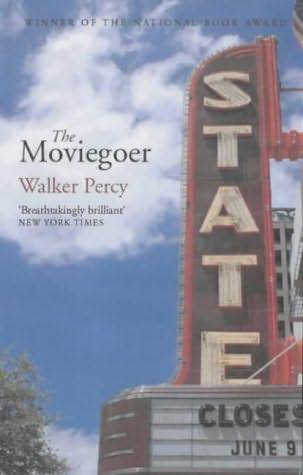 The Moviegoer, by Walker Percy, is as understated a philosophical novel as I have read. This 1962 National Book Award winner is set in New Orleans during the days leading up to Carnival. The characters we come across are largely high-society types who have been educated at elite northeast institutes of higher learning and now seem to be overly interested in what krewe they belong to. But the protagonist, Binx Bolling, who himself belongs to a well-to-do Louisiana family, seems out of place in this world. In fact, he seems to have one foot outside of whatever circle he is in.
Wounded in the Korean War, Bolling has returned to his native south and begun a rather uninspired, yet successful, career as a stockbroker. He is pestered by the notion that his family is disappointed he has not become a doctor and he is preoccupied by his endless “search.” Just what it is he is searching for, I suppose, is the driving force of the novel. Bolling is on this undefined “search,” afraid of malaise wherever it may exist and intrigued by the concept of repetition:
A successful repetition. What is a repetition? A repetition is the re-enactment of past experience toward the end of isolating the time segment which has lapsed in order that it, the lapsed time, can be savored of itself and without the usual adulteration of events that clog tim like peanuts in brittle. . . . How, then, tasted my own fourteen years since The Oxbow Incident? As usual it eluded me. There was this: a mockery about the old seats, their plywood split, their bottoms slashed, but enduring nevertheless as if they had waited to see what I had done with my fourteen years. There was this also: a secret sense of wonder about the enduring, about all the nights, the rainy summer nights at twelve and one and two o’clock when the seats endured alone in the empty theater. The enduring is something which must be accounted for. One cannot simply shrug it off.Walker Percy, I have since learned, shared his interest in repetition with Danish philosopher Kierkegaard. Though Kierkegaard is never mentioned by name, in the novel’s epilogue Bolling informs us, “As for my search, I have not the inclination to say much on the subject. For one thing, I have not the authority, as the great Danish philosopher declared, to speak of such matters in any way other than the edifying.”
The writing is crisp and the abundant descriptive passages are elegant without being unnecessarily decorative. No wasted words. Not one. Throughout the book my mouth was quite literally agape at the ease with which Percy was able to relate even the most minute details so precisely. In fact, the description of Bolling's family members was one of the most enjoyable aspects of the book. I had a fun time with this one. There is much humor to be found in these pages even though the protagonist meanders through a listless existence and the central female character, Bolling's cousin-by-marriage with whom he is in love, is riddled by mental illness.
The title of this book is a meaty topic that one could invest a lot of time in analyzing. On the surface we see, yes, Bolling frequents picture shows, he has a propensity to describe others in terms of their resemblance to film stars and on occasion he even relates events in his life to those in movies. But far more subtly, and likely of more significance to the author, is that he is divorced from life almost as though he were watching it on the big screen. Bolling is an adept voyeur and Percy supplies his protagonist was ample opportunity to show off his keen eye for the peculiarities of people and places with the generous descriptive passages I mentioned above. If only he had the ability to self-critique half as well, a sentiment his aunt echoes when she lays into with the following assessment:
First, is it not true that in all of past history people who found themselves in difficult situations behaved in certain familiar ways, well or badly, courageously or cowardly, with distinction or mediocrity, with honor or dishonor. They are recognizable. They display courage, pity, fear, embarrassment, joy, sorrow, and so on. Such anyhow has been the funded experience of the race for two or three thousand years, has it not? Your discovery, as best I can determine, is that there is an alternative which no one has hit upon. It is that one finding oneself in one of life’s critical situations need not after all respond in one of the traditional ways. No. One may simply default. Pass. Do as one pleases, shrug, turn on one’s heel and leave. Exit. Why after all need one act humanly? Like all great discoveries, it is breathtakingly simple.I'll stop now. In case the length of my entry does not make it clear, this is as fine a novel as I have read in quite a while. Strong recommendation.
Saturday, December 30
Empty handed
In addition to the cache of books discovered beneath the tree there was also a rectangular strip made from a substance others more worldly than I knew to be 'plastic.' Apparently I can use this plastic strip to barter for books at Barnes & Noble Booksellers. I know not what possible utility this plastic could serve the purveyors of books, but I am never one to quibble with current trends in bartering--as outlined in the just released Old Barterer's Almanac 2007--especially when, as in this case, I seem to have gained the upper hand.
It may or may not be interesting to note that until just recently I had always been more of a Borders man than a Barnes & Noble man. Borders, as you may know, began in Ann Arbor, and the flagship store on East Liberty really is quite marvelous. When I lived in Boston I used to go out of my way to shop at the Borders by Downtown Crossing even though I lived nearby the BU Barnes & Noble as well as the Prudential Center Barnes & Noble. Just one of those silly quirks of brand loyalty I suppose. But here in Seattle I quite prefer the downtown Barnes & Noble to the downtown Borders (Borders still reigns supreme in the music and DVD departments, but this is Book-Loop, where such ephemera are cast aside in favor of more scholarly pursuits). Perhaps as my college days grow more distant my bond with Borders slowly crumbles. Or perhaps it is simply the case that the Barnes & Noble is more comfortable, their staff far less intrusive as I browse, their patrons far more convivial. Granted, neither of these nationwide behemoths can hold a candle to the local gem that is Elliott Bay Book Company, and so this entire paragraph becomes obsolete.
Because of my allegiance to Elliott Bay it probably comes as no surprise that my Barnes & Noble gift certificate, while received with much appreciation, has caused me some frustration. I stroll through the aisles at Barnes & Noble in search of books I know to be plentiful at Elliott Bay and I come away wanting. No Davies, no Cheever, no Percy, no Marcus. Why, not even Catch-22 or The Brothers Karamazov, two classics that seem to have unforgivably slipped through the cracks of their shelves and mine. At one point I held Richard Ford's The Sportswriter in my hand. I put it back to browse some more and when I returned some time later, deciding that at the very least I could get that for now, it was nowhere to be found. I stormed out, no books in hand. Sure, I'll give them the benefit of the doubt, the holidays scurried away leaving the literature section in something of a drought. Hopefully a restock is in order, or I'll have to shift back to Borders.
But seriously, I did stumble across a Colson Whitehead book of essays regarding New York titled, The Colossus of New York. Not sure if either Bryan or Louis have read this, but seeing as how Bryan is now unashamed to refer to himself as a "New Yorker" I figured this might be of interest. I read the introduction and skimmed (it's true!) through other portions with great delight. If I, who has passsed through New York only a handful of times, find the book of interest, I thought others here might feel even more strongly about it.
Also stumbled across a book called 1001 Books to Read Before You Die, or some such foolishness. It seemed decent. But really, is every novel by Ian McEwan and Don DeLillo worthy of being placed in a top 1001? 1001 isn't really a lot when you consider the list begins circa 600 BC with Aesop's Fables.
Wednesday, December 27
A good haul
On Monday morning a large cache of books was discovered beneath a tree off Lambert's Cove Road. Here is how the treasures were divided:
Books now in my possession:
Sixty Stories - Donald Barthelme
The Stories of John Cheever - John Cheever
CivilWarLand in Bad Decline - George Saunders
The Areas of My Expertise - John Hodgman
The Paris Review Ineterviews, Volume I
The Better of McSweeney's, Volume 1
Books for Mom:
We Tell Ourselves Stories in Order to Live - Joan Didion
Brick Lane - Monica Ali
The Echo Maker - Richard Powers
Books for Dad:
A Madman Dreams of Turing Machines - Janna Levin
The Geographer's Library - Jon Fasman
Waiting for the Barbarians - J.M. Coetzee
The History of the Siege of Lisbon - Jose Saramago
Yiddish with George and Laura - Ellis Weiner and Barbara Davilman
Books for Brother:
The Best American Nonrequired Reading 2006
A Fictional History of the United States (with Huge Chunks Missing)
100 Hikes in the Inland Northwest
What books did you all get? Louis, you get anything good?
Saturday, December 2
Books for the non-reader
I have this brother. Smart chap, a graduate of a fine Big Ten institution, a fan of many "literary films" and, from what I know, a generally thoughtful and soulful person. But you put a book of more than 200 pages in front of him and he'll act like a eight year old staring down a heaping pile of slimy lima beans. He ain't having it. The occasional exception to the rule seems to be the random sci-fi or fantasy novel--books that lay far outside the realm of my notable gift-selecting prowess. For years the only book that I gave him was a volume of Simpsons comics each Christmas. This went on for about six years until, with me in college and he in his mid-twenties, it just didn't feel right. I have since moved on to giving him the annual collection of Best Non-Required Reading, a gift he says he enjoys but one is never sure just how much of it he actually reads.
This year I have been giving much thought to what novels I might be able to give him that won't go unread. I have considered The Gunslinger, the first volume of Stephen King's Dark Tower series. People seem to like, but who knows, the only King book I have read is The Shining, an altogether different affair. Then there is Neal Gaiman's American Gods, a fairly literary novel with enough fantasy that its length might prove to be a non-issue. Also, I have considered Benjamin Kunkel's Indecision, a humorous debut novel about a twenty-eight year-old slacker who takes a drug that cures his chronic indecision and soon finds himself romping about South America. While my brother might greet the humor and subject matter in Indecision warmly, I want not to have him think I am sending him some sort of not-so-veiled message about his own life--which would not be the case--so I have shied away from this one temporarily.
But, in general, what are some good books for the non-reader? Off the top of my head there are some obvious non-fictions like the work of Klosterman and Sedaris--breezy, fun books that seem to appeal to the well-read and unread alike. I struggle a bit more when trying to generate a list of novels. Perhaps this is because I am an elitist when it comes to the book gifts. Indeed, King seems rather too populist for my gift-giving sensibility. Something like Life of Pi is a swell choice, I think. And, while some skimmers might disagree, I believe the shorter novels of Murakami are a fine selection for a person such as my brother with an apparent taste for fantasy but an aversion to literature.
I could ramble on longer, but I come to you now from the communal computer in my apartment building and folks are waiting. If they only knew how urgent this Book-Loop correspondence was they would go upstairs, take a nap and give me more time, but no, they seem quite impatient.
Monday, November 6
Let's talk periodicals
No, the name of this blog is not Zine-Loop, but we should be open to the discussion of all things readable, whether it be books, magazines, skywriting, lost person notices on milk cartons, Marmaduke, graffiti scrawled on the side of speeding boxcars, and even an equation which governs particle settling velocity in fluid under laminar conditions tattooed on the arm of a confused engineer.
Two Book-Loop members who are not active contributors have expressed that they cherish their periodicals so much they have not the time for book reading. It's perfectly understandable. I now find myself in a situation with a new job and a plethora of magazine subscriptions (most of which came my way through gifts and free offers) and I worry that book time might be lacking. The larger issue facing me is that amongst my numerous periodical subscriptions there are only a few that I consider essential reading. I will probably subscribe to The Believer, The New Yorker and Sports Illustrated for the remainder of my life. Dime, ESPN The Magazine and Stuff are dying slow deaths. URB, Esquire, Wired, Time Entertainment Weekly are not likely to be renewed beyond their current run. Playboy is in limbo as well. The Economist is a new kid on the block and I look forward to the start of the free one year subscription I received in exchange for 900 or so Delta Sky Miles. The Paris Review and The Atlantic I enjoy reading, but I am not a subscriber. I think I'm saving those for my wizened, fireside-sitting, pipe-smoking years, which I plan to dive into somewhere in my mid-thirties.
What periodicals do you read? What periodicals do you recommend? What periodicals would you read if you had more time? What's the word on Mother Jones? I spent some time checking out the magnificent magazine collection at Elliott Bay this afternoon--a swell way to kill a rainy day while waiting on Pats/Colts--and was quite overwhelmed. I realize that the best way to find magazines you like is by reading magazines for yourself, but with so many hundreds of magazines out there I figured it would be neat to open up a little dialogue about the wonderful world of periodicals. I'm here to listen.
Friday, November 3
Friday, October 27
Pastoralia Ramblings
You might recall that my time with George Saunders was the literary highlight of my Bumbershoot experience in September. At that time I am fairly certain I was only familiar with the writer through an interview on The Sound of Young America and a discussion between he and Ben Marcus that is included in The Believer Book of Writers Talking to Writers. Saunders is a fascinating character. He has a B.A. in geophysical engineering, and worked in that field for about 15 years, picking up an MFA in creative writing from Syracuse University along the way. He now teaches creative writing at Syracuse, and just this year he was awarded a 'genius grant' from the MacArthur Foundation and a Guggenheim Fellowship. I have just now gotten around to reading some of his short fiction. I picked up Pastoralia at the library earlier this week, and after reading the title story I remembered why I so much enjoyed hearing him read aloud nearly two months ago. There's a certain charm to his satire that I think is missing in the work of many others. I don't know if 'charm' is quite the right word, but there is an honesty and a playfulness to it all rather than a lurking coarseness and bitterness. Don't get me wrong, his writing can be quite dark, but it always seems to maintain a hint of optimism that is slightly antithetical to his reputation as a distopian writer. But perhaps not. Regardless, he is an original and important American writer. I recommend his work.
Listen to Saunders on The Sound of Young America (Begins at 22:05)
I have also been continuing my journey through the drug-, ego-, and testosterone-fueled history of 1970's American film in Easy Riders, Raging Bulls. A little too gossipy for my tastes but a damn fun read. I wish I'd been making notes along the way because there are just too many great anecdotes to recount. One of my favorites involves the strategic drug use of the bat shit insane Dennis Hopper:
So how might this relate to the previous Book-Loop discussion regarding the acquisition of a writer's sometimes upsetting biographical details. Perhaps it's instructive that my new understanding of the salacious details of these filmmaker's private and professional lives has done little to weaken my appreciation of their work. If anything, reading the book has probably enhanced my appreciation of the films. My perception of Hollywood is that it's a seedy place--always has been. I expect bacchanalian excess and dirty double crossing. Not only do I expect it, but I think it adds to the legend and might even be an essential part of America's (dwindling) love affair with motion pictures. The written word is very different. Filmmaking is a group affair, vulnerable to in fighting, abuses of power and mutiny. Writing is a solitary act, it is personal. Why I place writers on a higher moral plane I cannot really say. I think it's mostly affect, but maybe it also comes from the (false?) idea that writing comes from the soul while movie making is one big put on--actors, costumes, make-up, sets, special effects, etc.--and even when it's a personal tale or a so-called auteur picture it lacks the one-on-one interaction that a book offers.
Ah, this post is a rambling mess. I seem to ramble much more on this blog than I do on my own. I'm not sure why, but I like it.
Listen to Saunders on The Sound of Young America (Begins at 22:05)
I have also been continuing my journey through the drug-, ego-, and testosterone-fueled history of 1970's American film in Easy Riders, Raging Bulls. A little too gossipy for my tastes but a damn fun read. I wish I'd been making notes along the way because there are just too many great anecdotes to recount. One of my favorites involves the strategic drug use of the bat shit insane Dennis Hopper:
One director wouldn't use him after lunch, when the alcohol kicked in. Another knew that Dennis would grab whatever was around--uppers, downers, what have you--and worried that, say, if Dennis took one drug during a long shot in the morning and a different one during a close-up in the afternoon, the energy levels would be different, making it impossible to cut them together. The two men went through the script and agreed on what drug Dennis would use in each of his scenes. When Hopper got the next day's call sheet, there was a notation at the bottom indicating the appropriate drug.I suppose this tidbit is of particular interest to me because it perfectly illustrates how, while the era is remembered for its freewheeling approach and active abandonment of Old Hollywood techniques, the people involved in these pictures were quite serious about their craft. I suppose that's obvious, you don't produce several of the greatest works in the history of film by simply ingesting drugs and letting the cameras role, but it's one of the major points that I take away from the book. Well, that and the understanding of how, like with so many great writers and musicians, the ego and ambition that fueled the work of, say, Peter Bogdanovich and Bob Rafelson, created relationships with friends and lovers that were tumultuous at best. They were endlessly philandering, self-absorbed and destructive. Indeed, it sometimes seems as though these traits are mandatory for achieving greatness in the arts.
So how might this relate to the previous Book-Loop discussion regarding the acquisition of a writer's sometimes upsetting biographical details. Perhaps it's instructive that my new understanding of the salacious details of these filmmaker's private and professional lives has done little to weaken my appreciation of their work. If anything, reading the book has probably enhanced my appreciation of the films. My perception of Hollywood is that it's a seedy place--always has been. I expect bacchanalian excess and dirty double crossing. Not only do I expect it, but I think it adds to the legend and might even be an essential part of America's (dwindling) love affair with motion pictures. The written word is very different. Filmmaking is a group affair, vulnerable to in fighting, abuses of power and mutiny. Writing is a solitary act, it is personal. Why I place writers on a higher moral plane I cannot really say. I think it's mostly affect, but maybe it also comes from the (false?) idea that writing comes from the soul while movie making is one big put on--actors, costumes, make-up, sets, special effects, etc.--and even when it's a personal tale or a so-called auteur picture it lacks the one-on-one interaction that a book offers.
Ah, this post is a rambling mess. I seem to ramble much more on this blog than I do on my own. I'm not sure why, but I like it.
Friday, October 20
Winning excerpts
"Instead of sulking, [Manny Ramirez] was more likely to put his cell-phone camera down his pants, take a picture, and interrupt other players' interviews to show them the image. Kevin Millar, apparently, was not impressed. Once he walked over to a naked Ramirez, pointed at his groin and exclaimed, "Forty home runs and 140 RBIs, and with this penis!" - Feeding the Monster: How Money, Smarts, and Nerve Took a Team to the Top
"[Bob Rafelson] was handsome in the Jewish way, a shock of dark brown hair over a high forehead, rosebud lips frozen in a permanent pout under a fighter's battered nose." - Easy Riders, Raging Bulls: How the Sex-Drugs-and Rock 'N' Roll Generation Saved Hollywood
"[Bob Rafelson] was handsome in the Jewish way, a shock of dark brown hair over a high forehead, rosebud lips frozen in a permanent pout under a fighter's battered nose." - Easy Riders, Raging Bulls: How the Sex-Drugs-and Rock 'N' Roll Generation Saved Hollywood
Wednesday, October 11
Up from the ashes
After several weeks of literary dormancy today the gears in my brain strained into motion. Actually, they were humming from the get go. I woke up, grabbed José Saramago's Blindness and was enthralled right from page one. An incredible feeling after nearly a month without focus or patience. Whatever the reason (and I think I know it) I seem to be back to normal.
After breakfast I made my way to Elliott Bay Book Co. to do some browsing. I read the preface to Natural capitalism and very nearly bought it before having one of those little internal meltdowns where you decide that you must get out of the store as soon as possible because you simply do not possess the resources to procure even a single book, and if you stay much longer you will almost certainly wind up exiting the store with five. So I put it back and made my way to the door. A little book titled "Speech of Chief Sealth" caught my eye and I stopped to give its innards a once over. An elder lady crept up alongside me and leafed through a different Native American non-fiction. She wandered off just as four books indiscreetly tumbled from the shelf and onto the rustic wooden floor. I quickly made an effort to shepherd the lost books back to where they would be more comfortable. Once I had placed the books back neatly on the self the lady, offering a reaction sufficiently delayed so as to suggest an incertitude of cuplability where there truly was none, asked "Did I do that?" I responded, "Oh, no, I'm fairly certain it was gravity." I gave her a wry smile and once again made my way to the exit. Netted in once again, this time by an autographed copy of Michael Lewis's latest book, The Blind Side, my departure was delayed further. I soon spotted Feeding the Monster, which, were I of sound mind when it was released a few months back, I would have surely bought it the very day it came out. So I bought it.
Walking home I passed a smiley faced man handing out reading material on the street. 'Jesus Saves!' 'Go Vegetarian!' 'No on I-933!' I was not sure what he was distributing but I accepted his offering graciously. I made an attempt to read it. I could not. It was a blank sheet of white paper. All his papers were blank. The man is a genius! I went into a shopping center where I sat and read the introduction to Feeding the Monster. Upon leaving I passed the man again but declined his handout, telling him, "No thanks, I've already read it."
Friday, September 29
Recent Perusals
Well, we can add Swann's Way to the growing list of novels that I lack the wherewithal to navigate in my current mindstate. I am in a significant reading rut and have decided to forsake the novel and spend my time perusing some short story masters.
A Good Man is Hard to Find and Other Stories - Flannery O'Connor
Sixty Stories - Donald Barthelme
Collected Stories - Isaac Babel
Selected Short Stories - Honoré de Balzac
Of the four I have to this point only completed a significant sample of O'Connor and Barthelme. This is my first experience reading either writer. "Grotesque" is the word that comes up again and again in discussion of O'Connor's work. Her stories are matter-of-fact and menacing in their portrayals of salvation. I am glad to be acquainted with her, and in awe of her ability to be so harmoniously dire and comedic. Barthelme is a writer of whom I could see the Book-Loop clan holding a mixed opinion. To me the man is downright brilliant. His short stories are brief, their relative simplicity belying an ingenuity of form. Why must "Postmodernist" be a pejorative label? But aside from the merits of his experimental style, Barthelme's stories are witty and far more playful in demeanor than the existentialists he is often lumped with. If a reader cannot delight in reading "Me and Miss Mandible" they should probably begin searching for a new hobby.
And yes, I am reading some non-fiction. On Mike's recommendation I picked up The Unfolding of Language: An Evolutionary Tour Of Mankind's Greatest Invention at the library. Pretty self-explanatory from the title, and, let me tell ya, the story is more interesting than you might imagine and the writing is far less stilted than you might fear. I also got a dense looking tome called The History of the English Language, an acquisition made with much optimism that shall probably return to the library unread.
Also:
The Office's John Krasinski adapting David Foster Wallace story
Reimagining Madame Bovary 150 years after her birth
The Wanderer: The Last American Slave Ship
Can Men Write Romantic Novels?
Housekeeping vs. The Dirt, by Nick Hornby
Tuesday, September 26
Joe Mathlete Explains Today's Marmaduke
Zach Warlick, my liaison to the world of irony, finds a keeper:
Joe Mathlete Explains Today's Marmaduke
Joe Mathlete Explains Today's Marmaduke
Monday, September 25
Bah!
Awaken, Book-Loopers! I will shoulder some of the blame for the recent silence - The Plot Against America was more like The Plot Against Midnight, as every subsequent page brought me closer to sleepy time. I'm still toting the volume with me, but only for the nebulous purpose of returning it "when I get close to the library," a strategy that has already once led me to renew my three-week loan. I'm currently waist-deep in Operation Yao Ming for journalistic researc purposes, and after that, I think I'm going to explore the newest Michael Lewis work, The Blind Side, about the changing of the NFL under Lawrence Taylor (or something like that). That's right: it's sports book month here on the loop!
Thursday, September 14
Regarding Jack London
From "The Man Who Would Be Jack London" in the August 2006 issue of The Believer:
H.L. Mencken, master of the hedged compliment, on London:
Writing in the New York Times Book Review, E. L. Doctorow pronounced London "the most widely read American author in the world." That's right. More than Twain or Hemingway or Melville. Something of a literary footnote in his own country, Jack London is considered an emblematic American author in Japan, Russia, Eastern Europe, and elsewhere. The Call of the Wild has been translated into eighty languages, more than any other American work. An Albanian anthology of American literature pictures Jack London along with Mark Twain on its cover. A collection of London stories in Russian sold 200,000 copies in the first printing. On his deathbed, Lenin asked his wife to read him a Jack London story.Who knew? Also, this man who readers of our generation (if they're anything like myself) know only from Call of the Wild, White Fang and perhaps To Build a Fire, wrote more than fifty books! This is a swell article that offers insight into a life that some would call "as romatic and ruggedly American as any novel ever written." We also encounter a rather comedic fellow who is a part-time Jack London impersonator, part-time hardware store manager.
H.L. Mencken, master of the hedged compliment, on London:
I have often argued that he was one of the few American authors who really knew how to write. The difficulty with him was that he was an ignorant and credulous man. His lack of culture caused him to embrace all sorts of socialistic bosh, and whenever he put it into his stories, he ruined them. But when he set out to tell a simple tale, he always told it superbly.
Spade Swann Bloom
Just to catch you up on things, my readings of both 1993 Was a Bad Year and City of Spades have been unsuccessful. With Bad Year I spent a few days reading and re-reading the first several pages. Nothing difficult to follow, nothing so beautiful that it demanded I linger, I just couldn't get beyond them. Whatever the reason I did not have the concentration for this book at this time--maybe it was too hopeless and not something I need to be reading right now. It is a very small book with fat print. I could read it in a about an hour. I could, but I couldn't. So, onto City of Spades. Not, as it turns out, "Britain's Catcher in the Rye. That label is designated for the second book in MacInnes's London Trilogy, Absolute Beginner. Meanwhile, this book, as the title not so subtly hints, is about London's influx of colonial Africans in the 1950s. With this one I made it to around page 50 before I decided that I was forcing the matter and I just needed to move on to Swann's Way. That's the thing, I should have read Swann's Way first. It has been sitting on my night stand waiting for me while I made these two futile attempts to read two books that I have only a mild interest in. I don't like giving up on books so early in the game but I've had some distractions and maybe Proust will allow me to focus.
I have also been hopping around Harold Bloom's Genius. It is a fun book in its own way. The manner in which Bloom has grouped the 100 writers and thinkers together into lustres makes the book easily navigable for someone like me who opts not to read all 814 pages in succession. The entries on each individual are brief, some of them providing an overview, others focusing on more specific qualities that Bloom finds most interesting. I have read so few of the works discussed in this book, but even without an intimate appreciation for many of the writers I am thoroughly enjoying the way in which Bloom makes connections between them, shaping in my mind a sort of outline for a family tree of poets, playwrights and authors. Inevitably it is Shakespeare who pops up again and again, but not always. Like the Book of Writers Talking to Writers, Genius is a book I will revisit often, whether it be for inspiration, edification or simple pleasure.
I have also been hopping around Harold Bloom's Genius. It is a fun book in its own way. The manner in which Bloom has grouped the 100 writers and thinkers together into lustres makes the book easily navigable for someone like me who opts not to read all 814 pages in succession. The entries on each individual are brief, some of them providing an overview, others focusing on more specific qualities that Bloom finds most interesting. I have read so few of the works discussed in this book, but even without an intimate appreciation for many of the writers I am thoroughly enjoying the way in which Bloom makes connections between them, shaping in my mind a sort of outline for a family tree of poets, playwrights and authors. Inevitably it is Shakespeare who pops up again and again, but not always. Like the Book of Writers Talking to Writers, Genius is a book I will revisit often, whether it be for inspiration, edification or simple pleasure.
Wednesday, September 13
Quoting Davies
"Do not suppose, however, that I intend to urge a diet of classics on anybody. I have seen such diets at work. I have known people who have actually read all, or almost all, the guaranteed Hundred Best Books. God save us from reading nothing but the best."
"The great book for you is the book that has the most to say to you at the moment when you are reading. I do not mean the book that is most instructive, but the book that feeds your spirit. And that depends on your age, your experience, your psychological and spiritual need."
"The great book for you is the book that has the most to say to you at the moment when you are reading. I do not mean the book that is most instructive, but the book that feeds your spirit. And that depends on your age, your experience, your psychological and spiritual need."
Tuesday, September 12
Old School
No, not the Will Ferrell movie that made you giggle the first few times you watched it but has since faded into irrelevance. I speak now of Tobias Wolff's novel that goes by the same name. A sharply drawn picture of life at an almost absurdly literary boarding school. In a strange way I think this might be the first book that has made me feel at all disappointed that I did not have the opportunity to attend a prep school of this sort. I mean, they get visits from Robert Frost and Ayn Rand and (if not for illness) Ernest Hemingway! Heady stuff.
These visits represent the source of much of the book's drama. Each visit corresponds with a school-wide contest in which the visiting writer selects one student's work to be read aloud and published in the school's literary journal. Most important for the students, of course, is the fact that these legendary writers would be selecting them as the winner--in their minds paving the way for an inevitable life of literary fame. The Frost visit is humorous, as he selects a student's work that he believes is a clever parody of his own poetry. He accepts the piece as good-natured ribbing, even though the student's intention had been only to write something Frost would find beautiful.
Rand also selects a student's work in which she is able only to see herself. But the contest takes on a secondary importance, as Rand's speaking engagement destroys our protagonist's enjoyment of her work. Like many young scholars he reads The Fountainhead and becomes enthralled with Howard Roark's boldness and virtuosity. Then, in this case from Rand herself, he learns what the writer really had in mind and the idolatry quickly vanishes. I strongly recommend the Rand section for anyone who still clings to the misguided belief that her philosophy is worth a damn. Wolff's characterization of Rand is hilarious, and even if it is a little harsh I would say that it is fully deserved.
The climax of the tale coincides with the approach of Hemingway's visit. Some of the students pretend to dismiss Hemingway, but none of them are able to avoid ripping off his style. In an effort to channel Ernest's ability our aspiring writer takes up the practice of re-typing Hemingway's short stories. The strategy works, in a sense, but the outcome is not quite what the young lad had in mind--the fact that the story ends up being a little more like F. Scott than Ernest is the least of his concerns.
As for complaints, I shall now turn you over to Thomas Mallon of The Atlantic, who has captured my two central points quite crisply:
Old School's somewhat pedagogical nature inclines one toward a few schoolmasterish objections. Its gradual accrual (three episodes from it appeared in The New Yorker) may have lulled the author into writing a last chapter that, although a rattling good story, seems more like an appendage than a conclusion.... And let me say this, above all, Mr. Wolff: the lack of quotation marks around the dialogue is a ridiculous piece of postmodern pretentiousness that has no place in your book. Not when it can stand with the best of what some old boys (Louis Auchincloss, Richard Yates) have produced in a waning American genre.
Saturday, September 9
Thursday, September 7
The Great American Novel
Great baseball satire, almost too light to write about. I read it in such a herky-jerky manner that I might have missed some stuff, but I doubt it.
I give it three PLDS games out of five.
I give it three PLDS games out of five.
Tuesday, September 5
Peak Oil
Being an environmental nerd (thus far mostly in theory - the practice is lacking, seeing as I spend a large portion of my time driving around LA), today's news of the oil deposit discovery down Mexico way got me thinking for a spell of black gold.
So far on Book-Loop it appears that the prevailing winds blow toward fiction. That's fine, but I am caught in a non-fiction spell that goes back 4 or 5 books or so and shows no obvious signs of letting up (the books at my bedside are What's the Matter with Kansas?, James Beard's Theory & Practice of Good Cooking, and The Joy of Sex, which I suppose you could consider fiction depending on the circumstances of the moment.
My question is, does anyone have any plans for non-fiction in the near future? If so, I would suggest a book on Peak Oil (which is exactly what it sounds like - the final peak in oil production. Ever.). I have not yet read a Peak Oil book, but I would like to. I was confronted most recently with the subject while reading an article in Harper's. Apparently, there is a lively Peak Oil community in the United States and I would assume around the globe. Peak Oil is not simply an inevitable event in the future, it is a movement of the present, populated by thinkers, crazies, scholars, business persons, and, well, anyone who has the ability to think critically about the consequences of a powerful, charging pattern of digging, pumping and burning that could competently serve as a shorthand for the recent history of human behavior.
This Harper's article included predictions, or rather meditations, of what life would become on an earth at Peak Oil, or on the immediate come-down. LTS mentioned thought experiments a while back. The thought experiment, or imagination experiment, of considering a realistic vision of an oil-dry planet is an intriguing exercise that probably is not undertaken enough outside the open discussion of a meeting of Peak Oilers. The scenarios are of course infinite, but some simple questions can be shocking if considered honestly.
What sort of war might we see over the last large deposit of oil on Earth? What might happen to our society if the price of gas rose to ten dollars per gallon over a period of ten years? The funny thing about thinking about this issue is that the only "what if?" in the scenario is the way in which the events of the peak and decline of oil production will occur. That they will occur is a plain fact.
Has short-sightedness always been a quality of the masses of humanity? I would think that the rapid pace of millennial (where are we, modern? Post-modern? I don't know these things) society would cause us to look ever farther into the distance since the consequences come at us faster and we will actually be around another 60 years or so to live more of them, supposedly. But, as a general observation, I feel that we are more short-sighted than ever in our hunger for progress.
Saturday, September 2
Happy Days
While we spend this Labor Day weekend feeling sad that Bryan will not be able to finish The Great American Novel, let us all be excited for me, who found a copy of Lydia Davis's award-winning translation of Swann's Way at the Seattle Public Library. Not only that, but also City of Spades, the first novel in Colin MacInes's London Trilogy ("Britain's Catcher in the Rye," says the March '06 issue of The Believer) and John Fante's 1933 Was a Bad Year. Yes, Book-Loop friends, between these books, last night's 826 benefit featuring Dave Eggers, John Hodgman, Sarah Vowell, and Daniel Handler (Lemony Snicket), plus tomorrow's Bumbershoot fun with Mary Gaitskill, George Saunders, Charles D'Ambrosio, Michelle Tea, The New Pornographers, Spoon, Common Market, Blue Scholars and so many more, it should prove to be a most stimulating Labor Day weekend for Book-Loop's Pacific Northwest Sector.
Friday, September 1
Dumbass
I forgot The Great American Novel at work yesterday, and I have only about 30 pages left, so it's kind of frustrating because I won't be back at work until Tuesday. In order keep things Roth-ing, I randomly picked up The Plot Against America from the library today. What has everyone heard? I'll probably forge ahead regardless, but I'm curious.
Monday, August 28
Translation
This is a topic that I had been kicking around in my head last week. When Louis suggested subtly that the translation of Murakami's prose may have stunted them, the topic jumped back into my thoughts.
I have an old, used copy of Swann's Way that I have been thinking about reading. The other day I was in the book store when I noticed that each volume of Proust's In Search of Lost Time is now available in a new translation. Not only a new translation, an award-winning translation that has received robust praise for numerous sources. The little staff recommendation note hanging below the new Swann's Way dismissed my poor old copy as anachronistic. I ventured to the library in the hope that I would find the updated version in their collection. Alas, their volumes of Proust are even more elderly than my own.
I suppose now is the time to ask, Has anyone read any Proust? Was it the updated translation or the 1922 translation? What did you think?
According to the blurbs, updated translations usually offer things like new life and improved fluidity of prose and access to subtle humor. For example, the 1996 translation of Magic Mountain is supposed to read far more easily than its predecessors, improving on their "stiff and forbidding" language.
The effectiveness of a translation is something that is apt to bother me so much while I am reading a book that I'll attempt to expel it from my thoughts and just pretend that it was originally written in English. But it's a HUGE factor for any book that one reads in translation. Thankfully most translators are amazingly talented. Any good writer will say that each and every word within all of their stories has been meticulously selected. Every word that sits on the page sits their actively, with purpose, they do not reside simply to fill some quota. To take each of the words, and the strings of words that they produce, and bring them into a new language is nearly as meticulous as writing the book in the first place. I just don't know how they do it. Bravo, translators.
Has anyone had an experience where they read a book they simply could not make it through, only to find themselves reading a different translation of that same book later on and enjoying it? My hunch is that many of the differences would be too subtle to swing one's appreciation so wildly from one pole to the other. As an amateur in the world of letters I would guess that updated translations are best suited for those who wish to expand an existing appreciation for a work. But odds are I am wrong. In fact, I know I am wrong. So wrong that I don't think I'll ever read my 1922 translation of Swann's Way. If a better translation exists, why bother?
Another thought, Why are the new translations always found in super deluxe editions? Yeah, the words are new, but why must that require paper of the highest quality and snazzy design work? Damn publishers.
Friday, August 25
What makes a book good?
While waiting for a top-secret, aka public, meeting of the New York Inquirer to begin, I cruised the Barnes and Noble a block away. It was raining, so I took my sweet time checking out the staff recommendations on the first floor (the escalator was out). On each shelf — fiction, non-fiction, classics, New York, "interesting," etc. — I saw two or three books that I have read.
My responses intrigued me. For instance, I saw The Effect of Living Backwards by Heidi Julavits, a book I did not enjoy while I read it - but its themes are burnt into my head. I also saw two David Sedaris books, Naked and Me Talk Pretty One Day, books I remember loving, but I can't recall a single episode from either of them. Sedaris may be a bad example, because his writing is purposely disposable, but what to make of Julavits? My experience with her book is almost the opposite of what I'm going through now with The Great American Novel. For whatever reason, I'm kind of having a rough go with it, but I only have good things to say about it, whereas I plowed through TEOLB despite my disdain for a lot of what was going on. The tricky part is that I remember a lot of it, and I would say it's a good book if you want to see the effects of shame. In some ways, it's kind of like Anchorman. I like quoting Anchorman, but I've never found it particularly funny when I watch it. That's obviously a strike against it, but with its sticking power, how big of a strike is it?
My responses intrigued me. For instance, I saw The Effect of Living Backwards by Heidi Julavits, a book I did not enjoy while I read it - but its themes are burnt into my head. I also saw two David Sedaris books, Naked and Me Talk Pretty One Day, books I remember loving, but I can't recall a single episode from either of them. Sedaris may be a bad example, because his writing is purposely disposable, but what to make of Julavits? My experience with her book is almost the opposite of what I'm going through now with The Great American Novel. For whatever reason, I'm kind of having a rough go with it, but I only have good things to say about it, whereas I plowed through TEOLB despite my disdain for a lot of what was going on. The tricky part is that I remember a lot of it, and I would say it's a good book if you want to see the effects of shame. In some ways, it's kind of like Anchorman. I like quoting Anchorman, but I've never found it particularly funny when I watch it. That's obviously a strike against it, but with its sticking power, how big of a strike is it?
Wednesday, August 23
Do you like to know your authors?
The question popped into my head this afternoon as I enjoyed a short story from Haruki Murakami's The Elephant Vanishes. I have read a handful of Murakami's novels over the past several years but it occurred to me while I was a reading a story titled, "On Seeing the 100% Perfect Girl One Beautiful April Morning", that I know absolutely nothing about the man. Then it occurred to me that I don't want to know anything about the man. I'm comfortable with the relationship I presently have with Murakami and his writing and I do not feel the need to push the boundary of my understanding.
It was only after I had read a fair amount of Saul Bellow's work that I began to make an effort to learn something about his life. Even then, my interest was prompted by a friend who had some less than glowing appraisals of Bellow the human being. My inquiry revealed that Bellow had a reputation as a misogynist, a bit of a racist and a part-time neoconservative with a distate for counter-culture. Disappointing revelations indeed, but with my fondness for Bellow's writing already well-established, I have been able to navigate around these unfortunate bits of information and separate the man from his fiction.
I remember distincly an incident when things did not work out quite so neatly. It was during my tenure at an educational software company in Boston. I was on my lunch break, eating lunch in the office break room. I was sitting there, munching on carrots, reading Spring Snow, when the rude and annoying project manager with outrageous halitosis joined me at the table. She noticed my book with some excitement and ventured into a lecture on Yukio Mishima's ritual suicide. When she was through I returned to my desk rather disturbed, and when the work day was done I returned Spring Snow to the library. I wasn't able to separate the man from his fiction because I was not given the opportunity to wander through his writing on my own. I was frustrated by the information I had attained--at least in part because of its source--and so I gave up on the book. I'll get back to it someday soon.
In many cases learning about the life of an artist can enhance one's appreciation for that artist. Unfortunately not all artists are admirable beings, and more than a few have some serious skeletons in their closets--one need not look any farther than the recent news of Günter Grass's secret SS past. Distinguishing the artist from the person behind the art is often easier said than done. I am unsure about what the role of the reader should be in terms of investigating the life of the writer. In most cases I try to avoid the biographical details altogether, but part of me thinks that it is the obligation of the discerning reader to dig into the details and attempt to find out what it is that makes a writer tick.
Discuss.
Sunday, August 20
The Intuitionist
There it is, printed right on the front cover: “The freshest racial allegory since Ralph Ellison’s Invisible Man.” That’s impossibly high praise for any novel to live up to. I did not quite realize what I was getting myself into with this surreal, fantasy noir (some even classify it as science fiction) and it took me some time to catch my bearings. Once I got in step with the rhythm of Colson Whitehead’s world (perhaps New York City of the mid-20th century) I enjoyed The Intuitionist.
The grand metaphorical relationship between elevator and upward racial progress is initially rather obvious. However, as the story develops this metaphor becomes cumbersome and difficult to uncurl. The fact that it is omnipresent throughout the tale does not help matters much. But rather than getting bogged down with my struggles to interpret Whitehead’s Big Idea, I delighted in becoming acquainted with some of the smaller aspects of the story.
Particularly fascinating to me was the character Pompey. It is Pompey, the only other black member of the Department of Elevator Inspectors, who Lila Mae blames for being directly responsible for her setup. She thinks him an Uncle Tom and is suspicious of him from the start. The lone black figures in the office are adversarial and impersonal rather than partners on the rise up.
I enjoyed the way in which Lila Mae slips into the party of co-workers undetected simply by wearing a maid costume. Her drunken co-workers, probably more than willing to look right through her anyway, do not notice Lila Mae at all in her simple disguise. Whitehead underlines the alienation of Lila Mae perfectly in this segment.
Also of interest is the fact that the most successful black character in the tale, James Fulton, had the ability to pass as a white man. I point it out because this idea is the central focus of two celebrated novels in the African-American literary canon that I highly recommend, James Weldon Johnson’s The Autobiography of an Ex-Coloured Man and Nella Larsen’s Passing.
The one major gripe I have with the book is the fact that Lila Mae is as cardboard a character as I have come across in some time--though I'd be willing to entertain the idea that this was intentional. I consider it rather adventurous for a young man to pen his first novel with a female character as the central figure. I know some writers who would find this opinion laughable, but I think it takes a special talent to pull it off. Now, obviously Whitehead is an immensely skilled and witty writer, extraordinary sentences abound throughout The Intuitionist. I only wish he were as generous with Lila Mae’s characterization as he is with his prose.
Bryan, you mentioned that I wouldn’t believe what you were doing when you read this book. Were you investigating an elevator catastrophe cover-up for the Queens Chronicle? Do tell.
This book is certainly ripe for discussion. Let us proceed.
Saturday, August 19
A book-loop suggestion
Despite MJA's noble idea of trading books - which was the impetus to get this wonderful site started, so it remains a wonderful idea - I don't foresee much of that happening on this site. So besides discussing books we have read independently, what could we do? Glad I asked! We could have the Book-Loop Book-Club! Or something to that effect. I got the idea when Louis and Ben were discussing Cloud Atlas and they abandoned ship because most of us hadn't read it. Why don't we pick a book every other month, or every three months, and plow through it together, posting our thoughts once we've all finished (or in real time, if everyone's got to a certain spot)? I say every 60 or 90 days at least so we have time to a) decide on the book, making sure it's one we all want to read and b) read other books in the interim. Since this is all very non-binding, you can ditch the book at any time, but it might be fun to do this. It also might be fun with especially long books, as we could give ourselves more time and plow through them together (I know this has been done online with Infinite Jest and Gravity's Rainbow, I remember Moacir telling me about it in college), and take them up chapter by chapter. In short, we could go back to school. Only we're smarter now.
I think it's at least worth a try...
I think it's at least worth a try...
Monday, August 14
Mitchell favorite to land Booker literary prize
That's my boy!
Here is the longlist for the Man Booker Prize for Fiction.
Black Swan Green seemed to be met with a cooler reception by British critics than American critics (small sample size, I know) and yet it is now the front runner for the Booker.
Critics who reacted negatively towards Black Swan Green seem to view it as a step back for Mitchell. While it is certainly not as daring as either Cloud Atlas or Ghostwritten in terms of toying with notions of time, setting, reincarnation, etc., or experimenting with interlinked stories featuring disparate narrative voices, it is far from a standard coming-of-age novel. In Black Swan Green we find Mitchell focusing on a very particular moment in time (Cold War England of 1982) a very particular place (Black Swan Green) and a very particular person (Jason Taylor). While not as grandiose as his past efforts, I hardly see this more microscopic focus as a step backwards. Rather, I think one could argue that in abandoning some of his tricks and telling a far more measured tale we see Mitchell maturing and bringing his writing to an even higher level.
One thing I am a little bummed about upon seeing the cover of the Black Swan Green U.K. edition for the first time is the fact that all of Mitchell's novels feature more interesting covers on the U.K. editions. See for yourselves:
U.K. Black Swan Green
U.S. Black Swan Green
U.K. Cloud Atlas
U.S. Cloud Atlas
U.K. Ghostwritten
U.S. Ghostwritten
Now, obviously the cover art is a rather inconsequential matter, but it's interesting to note that Black Swan Green is the first of Mitchell's novels that has not seen the inside of the U.S. version differ significantly from that of the U.K. version. In his first three novels the British terms (boot, lift, chips etc.) and phrases (lord only knows) were edited out and replaced by more commonly American-speak. But with Black Swan Green, as with many coming-of-age tales, the slang and local peculiarities of the town are an essential component to the story, so the words remained unchanged.
Sunday, August 13
Did the novel's ending make him uncomfortable?
"As if that blind rage had washed me clean, rid me of hope; for the first time, in that night alive with signs and stars, I opened myself to the gentle indifference of the world. Finding it so much like myself—so like a brother, really—I felt that I had been happy and that I was happy again. For everything to be consummated, for me to feel less alone, I had only to wish that there be a large crowd of spectators the day of my execution and that they greet me with cries of hate."
Bush reads Camus's 'The Stranger' on ranch vacation
Why is George Bush Reading Camus?
Honey, I Read "The Stranger"!
Bush reads Camus's 'The Stranger' on ranch vacation
Why is George Bush Reading Camus?
Honey, I Read "The Stranger"!
Saturday, August 12
You think you know a guy...
My plans to read The Tin Drum have been put on hold. Perhaps forever. It seems Günter Grass was in the SS. Sure this news doesn't alter anything that exists on the page, but it makes the idea of reading Grass pretty damn creepy to me. Has anyone read any Grass?
"Believing: it means believing in our own lies. And I can say that I am grateful that I got this lesson very early." - Günter Grass
Grass says literary reputation hurt by SS admission
Storm grows over Grass's belated SS confessions
Grass to retain Nobel despite row
John Irving defends author Guenter Grass
Grass' autobiography selling fast amid SS furore
It was Grass first and foremost who insisted the Germans “come clean” about their history and that his own generation should not try to pose as “victims” of Hitler’s National Socialist ideology. Now the great advocate of facing unpalatable truths has lived up to his own standards, but a little late.I just came across this quote that takes on new light:
"Believing: it means believing in our own lies. And I can say that I am grateful that I got this lesson very early." - Günter Grass
Grass says literary reputation hurt by SS admission
Storm grows over Grass's belated SS confessions
Grass to retain Nobel despite row
John Irving defends author Guenter Grass
Grass' autobiography selling fast amid SS furore
Friday, August 11
Parents and Books
Until the time I was about sixteen I held the horribly sexist belief that my father was a literary man and my mother just read silly detective novels. In some ways it wasn’t really my fault. The image I had of my father sitting on the couch, listening to Bach with a copy of The Magic Mountain in his lap and a bottle of Drambuie close by was not that far from reality. Though, in a strange way I think I somehow crafted this image of my father around the person that I thought he wanted to be rather the person he actually was.
I viewed my mother as the person who kept the house in order, broke up fights between my brother and I, and sometimes snuck off to read escapist mystery stories. Again, this image was not far from reality, but in this case I didn’t seem to take into account the person I thought my mother wanted to be—I had no idea what she wanted to be, my view of her was too narrow. My mother struggled to work books into her busy schedule and opted for quick escapism because that was the best therapy after the many hectic days. My father struggled to work his kids into his busy schedule and opted for classical music and literature as a way to escape from a different sort of reality.
As I’ve mentioned numerous times on my blog, one of the great joys of my maturity has been the discovery that my father and I share similar taste in both films and books. What I have failed to mention is the growing relationship between my mother and I that is based on talking about films and books. While my father and I share a similar fascination with figures like Kafka, Hesse, Bergman and Buñuel, we very rarely, if ever, discuss their work. Meanwhile, my mother and I have shared many enjoyable phone conversations recently about the films I’ve been watching and the books I’ve been reading. I introduced her to David Mitchell’s novels and she’s taken a great interest in them. When I was home around Christmas we had a long discussion about Bergman’s Through a Glass Darkly that I will not soon forget. Just the other day we chatted about Joan Didion.
Through these conversations I have learned a tremendous amount about my mother. It saddens me that it has taken so long for me to connect with my mother in this way. It was always just kind of accepted that my dad was the renaissance dude and we would defer to him on most things cultural. But the fact is that while my father has a tremendous memory for character and plot, he rarely seems willing to share his honest opinion on books. With some coaxing I’ve seen it done, but I’m hardly the person that should be coaxing others to open up. When I read my father’s copies of his favorite books I invariably find several pages bookmarked. I find myself wanting to know why and I try to figure it out on my own. I am rarely able to get inside of his head, and I rarely ask him to let me in.
These days my mother is the literary one and my father is the mystery. My parents haven't changed (at least not in any fundamental way) my approach has changed. I am no longer a simple observer of my parents' images, I am now an active participant in the decoding of those images.
(You know, I’m not sure whether this type of thing is of interest to Book-Loopers. It was sort of caught in-between this blog and the other one so I just deposited it here. I apologize if I have bored you.)
King of the Jews
 I just finished King of the Jews by Leslie Epstein (Theo pere). There cover of my copy is littered with praise for the book, most of it calling the novel the only important work of Holocaust fiction to that point. It was published in the early 80's. It was well-written but didn't blow me away; however, it's the best look inside the life of Jews during the Holocaust that I've encountered, as opposed to their deaths (Schindler's List) or their individual fights for survival (The Pianist), even if the fight to survive obviously permeated the book. The surprising aspect of the book is its optimism: the main character, I.C. Trumpelman, refuses to fight the Germans for fear of getting his whole ghetto deported to a death camp, and constantly preaches to his skeptical neighbors that working with the occupiers is better for the Jews in the long run. As President of the local Judenrat, or Jewish Council, in the Balut ghetto, Trumpelman radiates a confidence that doesn't extend to some of the Balut's younger residents, who rebel against him and the Germans; somehow, he holds the Balut together longer than any of the other Polish ghettos. The general optimism was a fresh take, and I think was the reason the book is well-regarded - I enjoyed it for that reason, but couldn't escape the fact that it was obviously certainly fantasy, even if I wished it wasn't.
I give it three sad things out of five.
Thursday, August 10
Finding George Orwell in Burma
I was sitting in the park enjoying the sterling 80-degree weather the other day. I was reading Finding George Orwell in Burma and enjoying it quite thoroughly. Then a crow shat on my knee. The poo fell from high above with much velocity and dribbled down my leg. I stopped reading and scurried off to the bathroom to clean myself.
The reason I mention my plight with the poo is because I think it relates to colonialism. Big fat cawing crows fly in from elsewhere and perch high above the citizenry. They then proceed to shit on the citizenry without pause. Once they have done all they can, they fly away home leaving a mess so great that efforts to clean it up are almost futile. Colonialism: The shit stain that won’t go away.
Anyway, my inane analogy aside, this is a fascinating little book. Writing under the assumed name of Emma Larkin (using her real name would spell doom for her friends in Burma and would make any return trips to the country quite dangerous) an American journalist based in Bangkok authored this peculiar combination travelogue and literary criticism. George Orwell's connection to Burmas was quite deep, he was born in colonial India, was stationed in Burma as a member of the Indian Imperial Police, later wrote a novel called Burmese Days about his experience in Burma, died in 1950 while in the process of writing a novella about “how a fresh-faced young man was irrevocably changed” after his time in Burma and, most importantly, modern-day Burma shares many characteristics with Orwell’s two most famous books, Animal Farm and Nineteen Eighty-Four.
There is an overwhelming Big Brother presence in Burma, and Larkin encounters people who are fearful of having conversations with her in teashops, concerned that an informant could be lurking. Larkin altered most of the names used in the book, even several of the locations, in an effort to the spare the well-being of those she spoke with. The newspapers feature a ridiculous collection of stories about government officials traveling to and fro while failing to mention practical matters like a fourfold increase in train fares. In an effort to conceal bad news the government makes all news hard to come by. Even the Buddhist monks are controlled by the government, and their large influence is used to help keep people in step with the police state’s policies. Burma is second only to Afghanistan in the amount of heroin it produces and this heroin is predictably used to deepen the pockets of government officials while the masses struggle.
The response of a Burmese man when asked by Larkin why the people appear so carefree despite the conditions within the oppressive police state: “Burma is like a women with cancer, he explained. She knows she is sick, but she carries on with her life as if nothing is wrong. She refuses to go to a doctor for treatment… She talks to people they talk to her. They know she has cancer and she knows she has cancer, but nobody says anything.”
Larkin does a good job of giving a feel for how tyrannical the Burmese government is but I wish she had delved a bit further into her analysis of Orwell’s writing. Too often her discussion of Animal Farm and Nineteen Eighty-Four seemed like an afterthought. She sprinkled the book with little ancillary tidbits that never go beyond a most basic understanding of Orwell’s writing. But I found the book in the travel literature section and travel literature it is. Pretty good, too.
Wednesday, August 9
Loopers, ahoy!
Hi everyone, specifically Nick, Rafe, and LTS. You three should each create one post with your name as the title, and then I (or someone) will make the sidebar link to your profile. This post will be your profile which you can change at will. As long as you don't change the title of the post, the link will operate nicely.
Meanwhile, I've been busy battling Tally Hall and LA sewage, so I have not been Looping lately. Rest assured that will be rectified, though I wither a bit in the shadow of the eloquent and verbose actual writers in the Loop. Inspiration, not intimidation, I must remember.
An old man told me, "Your days are for running, and your nights are for dancing until it is day."
Alright, Book-Loopers...
Let's get some activity going here. Let's hear everyone's favorite fiction work, non-fiction work, and a wild card, which you can use to talk about anything. I'll go first.
Fiction: Infinite Jest
I've read better novels than Infinite Jest, but the fact I finished the fucking thing makes me put it here: I still consider it an achievement. That said, it's a great novel, and I remember the details of it vividly even though I read it 8 years ago. It follows three stories concurrenly, if not temporally. The first is the story of young Hal Incandenza, a pot-addled teenager enrolled at the Enfield Tennis Academy in Boston, which is run by his mother, Avril, after the father's suicide. The second story is tha of ex-con Don Gately, who lives in a halfway house just down the hill from the Academy, and the third is a conversation between a wheelchair-bound assassin and somebody else on the American-Canadian border. Yep, it's a riot. On top of the 1100 pages of text, there are 100 pages of footnotes. This book is kind of like an acid trip in that I don't think I have the time and energy for it now, but I did back then, and I'm better for it. A really suberb experience.
Non-Fiction: The Power Broker
Quite simply the greatest book I have ever read. In recording the story of Robert Moses, New York's Parks Commissioner-turned-Czar, Robert Caro won a Pulitzer Prize and essentially wrote the post-Tammany Hall history of New York City. I would definitely say it helped to read the book while living in the city, just because every single part of the city, and how it was created, is discussed in the book, which like IJ is over 1000 pages. The amount of research is simply staggering, and it's baffling to think Caro wrote three (!) of these books on Lyndon Johnson, but that may be overkill. Maybe I'll get to them and like them more. But for now, this is the one.
Wild Card: Crappy Books
Yes, I could have gone with some Gabriel Garcia Marquez or some shit like that, but why? On occasion, I read crappy Robert Ludlum novels like The Prometheus Deception, which itself was a running joke between myself and BAG. While the plots of these books are standard (thirty-to-fourtysomething white hero, unnecessarily hot female along for the ride, predictable plot twist), it would be wrong to think you can't learn something by reading them. They're page-turners, which means they're almost uniformly well-written; they may be uninspired, but great ideas alone won't get you into Barnes and Noble. You need to keep people's attention, and I find I learn something about reading - which helps my writing - by tearing one of those books apart, and it only takes a couple hours. And there's guns and sex and stuff, which is fun.
Subscribe to:
Posts (Atom)